What to Expect with Custom Furniture
I want a custom piece of furniture...what's next?
This typically is the next question after an initial inquiry. Consumers sometimes will avoid custom furniture for this exact reason, and trust me, I completely understand! "I don't know what type of wood I want", "What dimensions do I need?", "Do I want a metal or wood base?", "What is live edge?", "What is a river table?", "Epoxy or glass?" The list goes on and on. Although all of this can be very frustrating, it is all fairly simple! DO NOT LET THIS SWAY YOU TO A MANUFACTURER! I am here to help every step of the way.
When it comes to getting that perfect size dining table or the ideal fit for a piece of handmade furniture, it is most important to know your overall dimensions. For example, let’s start with a dining table. The rule of thumb for a dining table to be functional is a minimum of four to six inches between each guest. This will allow for a comfortable amount of elbow room when dining. Another important factor is how much space to leave around the dining table? The most common answer is 36 inches. This dimension leaves an adequate amount of space for you and your guests to access their dining seats with ease. Now, I do understand that not all live edge tables are symmetrical, so there is always a little wiggle room within those dimensions.
Ok, now that you have figured out your (rough) dimensions, let’s talk about your custom wood species. There are many different types of wood available, and we could be on this subject for days (scroll down to see my favorite species). But let's start with the basics. Dark or light? Decipher the style of table that would fit within your interior design. Modern? Rustic? Contemporary? These are all great things to consider when thinking of a custom piece of furniture or dining table.
So let’s discuss some of my favorite options. If you are wanting a darker-toned live edge table, river table, or dimensional table, an industry favorite to work with is always Walnut. Being a domestic tree, Black Walnut, Bastogne Walnut, and Claro are guaranteed to be a natural beauty. This very dense wood typically has a reddish or dark brown undertone with highlighted grain patterns throughout. Although a little higher priced, you are guaranteed a finished product that is not only very durable but will not disappoint aesthetically. Another darker route to take, as well as two of my personal favorite custom wood species to work with, are Guanacaste (a.k.a Parota) and Monkeypod. These beautiful exotic trees have some of the most unique figures and can be sourced up to 30 feet long in one single live edge slab! Not only do they make a great choice for large, wide dining tables, but they also make a fantastic choice for conference tables as well! These beautiful exotic hardwoods create a statement piece that will give every guest in your home or business a "wow" experience.
Now that we have covered some of the darker options, let's shift to the lighter spectrum. One of my all-time favorites to work with, which makes for GREAT river tables, is Maple. These highly figured slabs will have reddish to yellow tones and typically showcase amazing figure throughout. They include great features such as Blistering, Quilting, and Spalting. Not only do they make a great single slab live edge table, but their heavy figured live edge also makes for superb river tables.
Are you a little more traditional? Do not want a live edge table? A river table? Or even an epoxy table? "I just want a traditional table!" DO NOT FRET! I can make classic tables out of dimensional Walnut, Maple, Hickory, and many others such as white oak or ash.
Finally, last but not least, let's discuss your table base. Did you know Citizen Wood Company shares a commercial space with a metal fabricator? THAT'S RIGHT! I have our metal forger on-site to help with your design! Nickel Handcrafted custom makes our bases and metal designs right on-site, so there are many options to choose from. What's even more impressive is our friends at Nickel Handcrafted have technology to show you what your base or metal build will look like even prior to manufacturing! WHOA! Everything you want is kept in one space when customizing your piece of furniture.
Now I know this doesn't cover absolutely every question you may have, but my hope here is to help you, the consumer, take the next step in supporting a small local business and purchase a high-quality, handmade dining table, river table, epoxy table, or a piece of custom furniture that will last for many years to come. Thanks for reading!
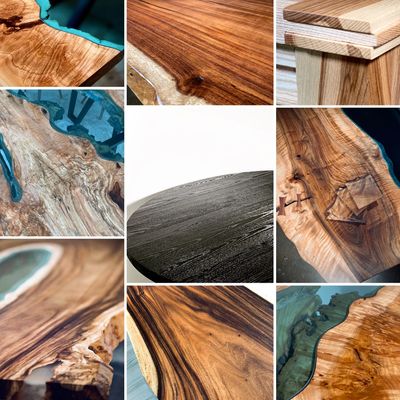
Live Edge Tables, River Tables, Dimensional and Round tables, Epoxy Tables and more!
Walnut Species

Bastogne Walnut
Heartwood colors can vary from lighter golden yellow to reddish brown, sometimes with darker brown to nearly black streaks. Paler sapwood isn’t always sharly demarcated from the heartwood. Curly or rippled grain is also seen on some sections.
(information from wood-database.com)
Black Walnut
Heartwood can range from a lighter pale brown to a dark chocolate brown with darker brown streaks. Color can sometimes have a grey, purple, or reddish cast. Sapwood is pale yellow-gray to nearly white. Figured grain patterns such as curl, crotch, and burl are also seen.
(information from wood-database.com)

Claro Walnut
Heartwood can range from a lighter pale brown to a dark chocolate brown with darker brown streaks. Color can sometimes have a gray, purple, or reddish cast. Sapwood is nearly white. Wood from orchard trees that have been grafted with English Walnut may have a colorful/streaked appearance near the graft, which is sometimes referred to as “marbled Claro Walnut.” Claro Walnut can occas
Maple Species
Maple Burl
color ranges from nearly white, to an off-white cream color, sometimes with a reddish or golden hue. The heartwood tends to be a darker reddish brown. Bigleaf maple is known for its quilted/blistered grain patterns.
(information from wood-database.com)
Big Leaf Maple Burl Table
Maple Burl River Table
color ranges from nearly white, to an off-white cream color, sometimes with a reddish or golden hue. The heartwood tends to be a darker reddish brown. Bigleaf maple is known for its quilted/blistered grain patterns.
(information from wood-database.com)

Spalted Maple
Spalting is simply a fungal discoloration of wood, and can be found on a wide range of wood species and genera. It is found in wood that has begun initial stages of decay, and is then subsequently dried (preventing further decay). The partial decay, called spalting, can give the wood dark contrasting lines and streaks where fungus has begun to attack the wood. If the wood has been r
Exotic Slabs

Monkeypod
Color tends to be a golden to dark brown, sometimes with darker streaks. Sapwood is usually thin and yellow/white, clearly demarcated from the heartwood. Monkeypod is sometimes seen with highly figured curly or wild grain patterns
(information from wood-database.com)

Mexican Parota
Costa Rican Guanacaste (Parota)
Heartwood is light to medium brown, sometimes with a reddish hue. Darker streaks of brown are sometimes present. Sapwood is pale yellow and is clearly demarcated from the heartwood.
(information from wood-database.com)
Local Wood Options (dimensional)

Shou Sugi Ban White Ash
Shou Sugi Ban (or Yakisugi) is an ancient Japanese exterior siding technique that preserves wood by charring it with fire. This environmentally friendly way to preserve timber not only gives a waterproof finish, but makes for one cool jet black piece of furniture!